When it comes down to it, like it or not, a good deal of mortgage activity — like refinances and whether potential homebuyers will go for that big purchase — depends on what the rates are doing, and if they’ve been trending up or down.
The Mortgage Bankers Association (MBA) describes it as a simple equation: as rates move downward, expect more mortgage applications.
As far as the latest moves, the 30-year fixed rate mortgage (FRM) has been trending upward for the last three weeks, and the same goes for the 15-year FRM.
With the latest slight bump up this week, three basis points for the 30-year FRM and two for the 15-year FRM, Freddie Mac’s Chief Economist, Sam Khater, urged prospective homebuyers to “shop around” to get their best mortgage rates — something loan officers should keep in mind.
Here at the end of May, National Mortgage Professional is examining where rates have gone this year and what they’re expected to do as this year progresses — and some of the "why" behind that — which plays a role in the ongoing U.S. housing affordability problem.
One relied-upon source of mortgage rates is Freddie Mac’s Primary Mortgage Market Survey (PMMS), which focuses on conventional, conforming, fully amortizing home purchase loans for borrowers who put 20% down and have excellent credit.
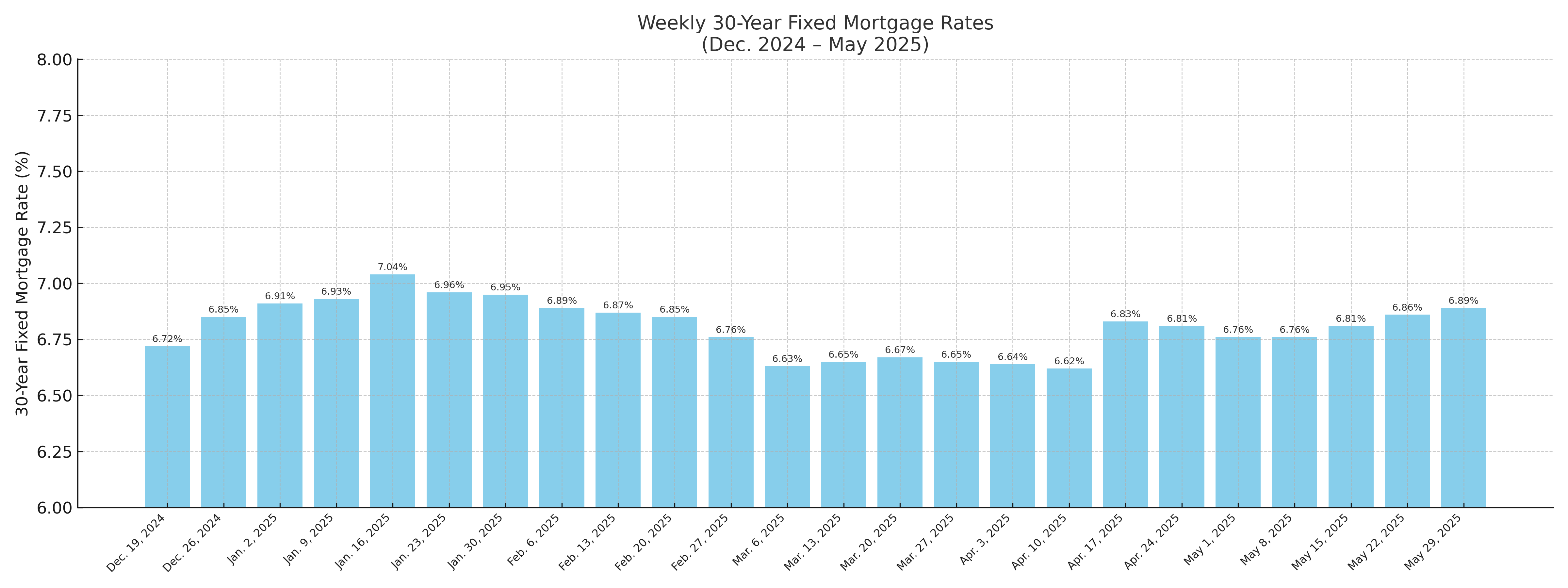
According to Freddie Mac's survey, here's what the 30-year fixed-rate mortgage has averaged from Dec. 19, 2024 through May 29, 2025:
Click to enlarge
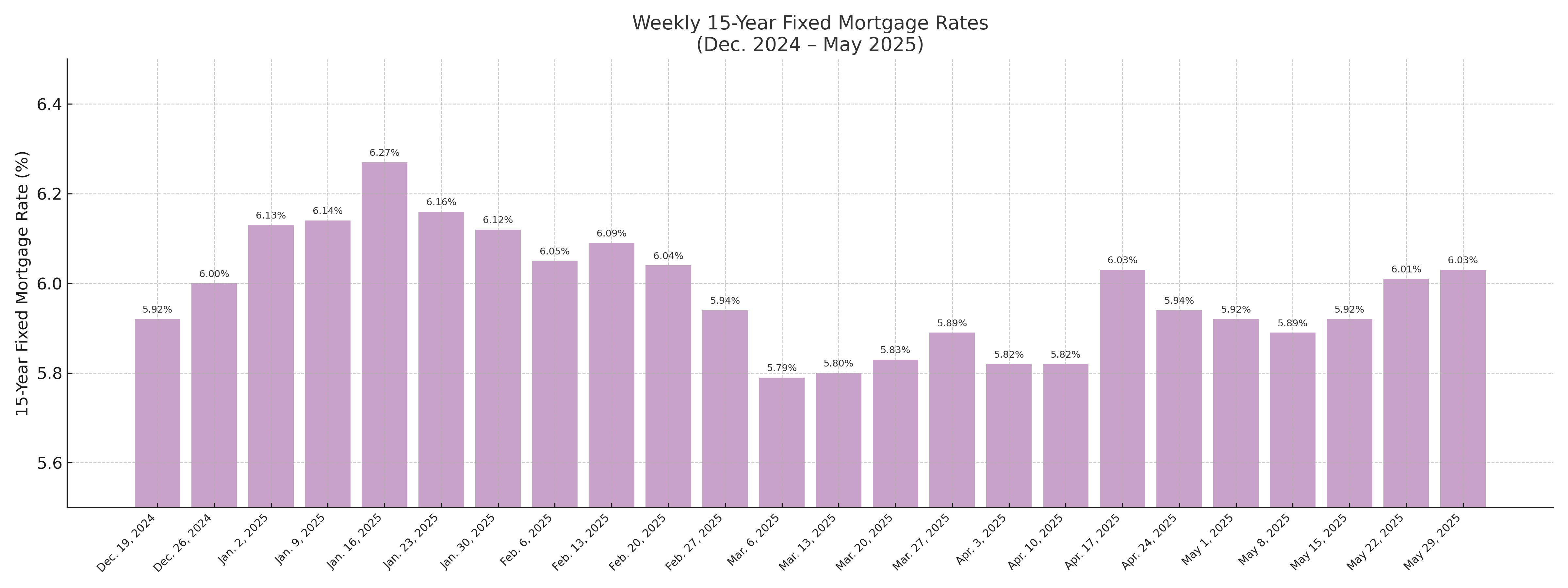
Freddie Mac's PMMS data shows the 15-year fixed-rate mortgage averaged, again from Dec. 19, 2024 through May 29, 2025:
Click to enlarge
Backdrop Leading Into 2025
On the approach to 2025 and a new administration that was about to be installed in Washington, D.C., economists and executives from a range of mortgage companies all said the same words: volatility, uncertainty, unpredictability. Most expected it’d be a guessing game with rates as President Trump implemented new economic policies he had campaigned and was, in part, elected on.
Multiple economists and housing market professionals have pointed to a cloudy economic outlook as holding many buyers and sellers back, but also potentially affecting mortgage rates.
Helping provide such murkiness is the on again, off again use of tariffs and the economic uncertainty/ “trade wars” that have resulted, and have yet to see a resolution. Federal courts this week ruled the President cannot unilaterally impose tariffs, striking many tariffs from the books, while the U.S. Court of Appeals for the Federal Circuit yesterday ruled the other way, delaying any de-implementation of tariffs the other courts had ordered.
Fed, Federal Government Friction
And there is also the Federal Reserve Board, which faces growing impatience from the Trump Administration with its decision so far this year to not lower its federal funds rate, which currently stands at 4.25% to 4.50%. Economists believe that generally, as the federal funds rate falls, the effect will trickle down and mortgage rates will follow suit, although there is no guarantee of that.
In a private meeting Thursday at the White House with Fed Chairman Jerome Powell, President Trump called it “a mistake” not to lower interest rates, while Powell insisted that any decision to do so would be “based solely on careful, objective, and nonpolitical analysis,” as reported by The New York Times.
Meanwhile, in a post earlier this week on X.com, Federal Housing Finance Administration (FHFA) Director and Chairman of Freddie Mac and Fannie Mae, Bill Pulte, expressed exasperation with the Fed Chairman.
“Jay Powell needs to lower interest rates — enough is enough,” Pulte wrote. “President Trump has crushed Biden’s inflation, and there is no reason not to lower rates. The housing market would be in much better shape if Chairman Powell does this.”
And meanwhile, with recent talk from President Trump of taking Fannie Mae and Freddie Mac public and again trading their shares on a major stock exchange, Pulte contended this week that making such a move could bring downward pressure on mortgage rates, and in turn improve affordability in the U.S. housing market.
So it’s fitting to turn to one of the government-sponsored enterprises, Fannie Mae, for a prediction of where mortgage rates will go as the year progresses. The company forecasts that the 30-year FRM will end 2025 at 6.1%, which currently gives it nearly an 80-basis-point spread to close.
Notably, that outlook is slightly rosier as of late, indicating the company is seeing some positive economic signs. Before its most recent market forecast, Fannie Mae had said it expected the 30-year FRM would finish out the year at 6.2%.