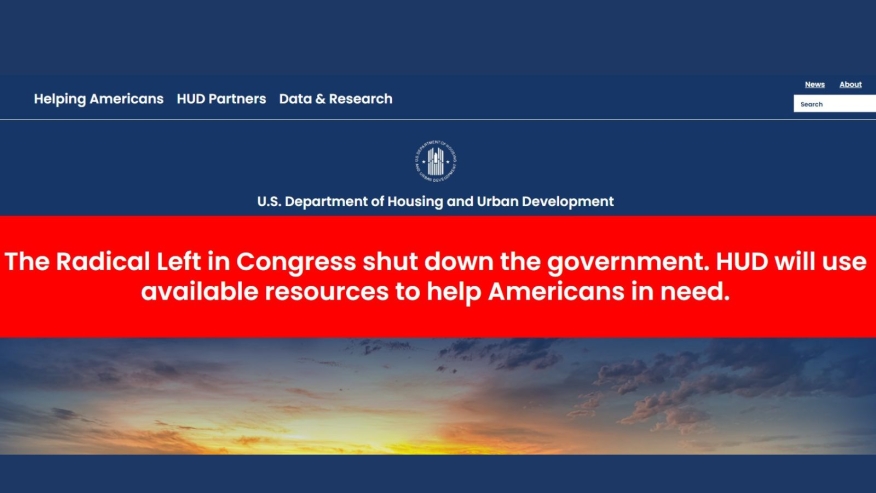
As the federal government entered a partial shutdown at 12:01 a.m. on Oct. 1, the U.S. Department of Housing and Urban Development (HUD) placed bold, partisan language on its official website blaming the “Radical Left” for “shutting down the government,” unless its demands are met.
On Sept. 20, the banner previously read: “The Radical Left are going to shut down the government and inflict massive pain on the American people unless they get their $1.5 trillion wish list of demands. The Trump administration wants to keep the government open for the American people.”
The backdrop is a standoff in Congress over how to fund the government past a deadline. Republicans pushed a clean continuing resolution (CR) to keep funding for several weeks; Democrats refused to support that without negotiating additional priorities, such as healthcare extensions.
HUD Secretary Scott Turner posted a similar message about the “radical left” on his official X account Tuesday morning, Sept. 30, adding that, “HUD.gov has been updated accordingly.”
HUD released a 2025 shutdown contingency plan for a lapse in funding on September 29, 2025.
Legal observers immediately flagged potential violations of the Hatch Act, which prohibits federal agencies from engaging in political activity in their official capacity. Critics also argue the move violates norms of nonpartisan communications and misuses taxpayer-funded platforms for partisan advocacy. However, HUD defended the messaging, saying it avoided references to candidates and focused on ideology.
Mortgage Industry Leaders Respond
For lenders, the disruption is immediate. “There may be some limited services continuing, but in our communications, it’s clear that most operations have been halted,” said Eddy Perez, CEO of Equity Prime Mortgage.
The most immediate disruption lenders face is at USDA, which has furloughed roughly 80% of its rural development staff. That leaves the agency unable to issue loan guarantees or provide conditional commitments. “That will cause immediate challenges for lenders with heavy USDA pipelines,” said Frank Razi, Chief Credit Officer at Equity Prime Mortgage and a former HUD/FHA director.
Other agencies are functioning with fewer interruptions. VA lending continues “largely business as usual,” he said, though staffing shortages may slow down complex cases. Ginnie Mae is still issuing commitments, securitizing mortgage-backed securities, and monitoring defaults. FHA is continuing endorsements, though HRAP condominium project approvals are suspended. DELRAP condo reviews are unaffected, and many endorsements handled by contractors should avoid serious delays. Conventional loans through Fannie Mae and Freddie Mac remain untouched.
Amir Abuhalimeh, vice president at West Capital Lending and the company’s top-producing loan originator in September, said that the impact of the shutdown will vary depending on loan programs. He offered a more tempered assessment, saying "“I don’t think there’s going to be any specific immediate impact on business besides the fact that FHA mortgages could be endorsed at a slower rate, and USDA could be guaranteeing at a lower rate as well."
For Abuhalimeh, his business is weighted toward government lending and could feel the slowdown if the shutdown drags on: “Personally, I do not originate many USDA loans. My business is heavily weighted toward government loans, specifically FHA and VA. If those institutions continue to be slowed down, then the longer the shutdown lasts, the greater the potential impact. Looking back to December 2018 through January 2019, when the shutdown lasted 35 days, there were only minor delays in new home purchase processing. In this case as well, much will depend on how long the government remains shut down.”
But Razi also pointed to broader risks: if staffing cuts being floated in Washington become permanent, FHA and VA services could face lasting slowdowns. Closings could be significantly delayed depending on how long existing funding stretches to retain staff. He also flagged a “particularly concerning issue” in flood insurance: FEMA cannot issue new or renewal policies during the shutdown, leaving borrowers dependent on private coverage.
Abuhalimeh also shared concerns about homebuyers facing delays in getting flood insurance. “I also believe that for new home purchases, the fact that flood policies won’t be issued in a timely manner could potentially affect those transactions," he said. "At the same time, with investors starting to move away from stocks and into bonds, we’re hopeful this could help bring interest rates down in the short term.”
Communication with borrowers, he added, is critical. “We are letting our borrowers know that we have been through this before, during the 2018–2019 shutdown. We are watching the market very closely here at West Capital Lending to make sure borrowers are in the best position with their new home purchases," Abuhalimeh said. "If we see anything in the news that rises to the level of potentially affecting their homebuying journey, we will notify them right away. For now, everything appears to be moving in the right direction, and we don’t see a direct negative impact for buyers currently searching for a home.”
Still, EPM's Perez underscored the wider disruption beyond housing. “Agencies like TSA will stop receiving pay, and we could see employees stop showing up to work. If this continues, it could become a very serious and disruptive situation,” he said. Perez also raised concern about the tone from Washington: “There is some alarming rhetoric coming from leadership, including talk of dismissing federal workers altogether. If that rhetoric turns into action, the consequences could be long-lasting.”
Other observers expressed concern that HUD’s partisan messaging could further undermine trust. "I am disheartened by all political rhetoric by government agencies, and I am concerned surrounding any potential Hatch Act violations," said Bob Niemi, director of government affairs for Weiner Brodsky Kider PC. "This kind of messaging undermines trust in HUD’s neutrality and could erode confidence among lenders and borrowers who rely on federally backed programs."
"I am doing my best to stay optimistic, but I am definitely shaking my head," Niemi added. "HUD has always represented our best efforts to support affordable housing and serve all of us, and not just the right or the left."