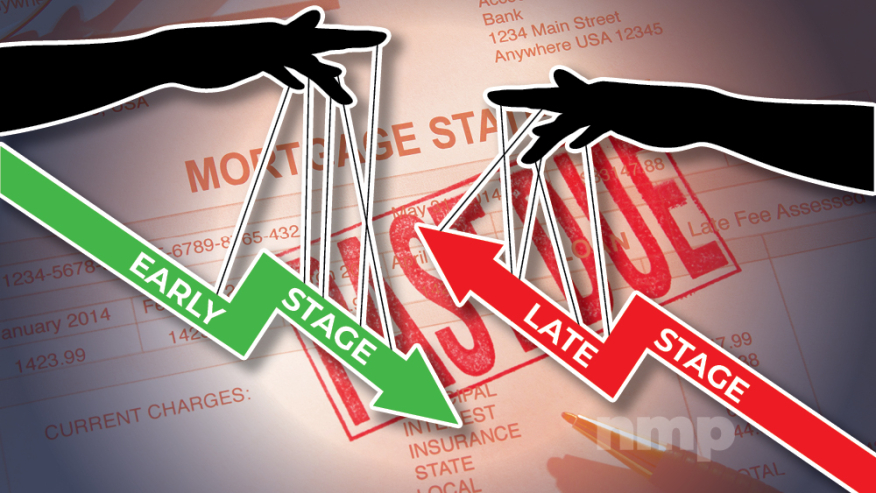
Mortgage performance improved in March, but not in a way originators should read as purely positive.
New data from Intercontinental Exchange (ICE) show delinquencies declined seasonally, while prepayment activity surged to its highest level in nearly four years, a combination that reflects both stabilizing borrower performance and a reawakening of refinance activity in response to earlier rate dips.
At the same time, deeper credit stress continues to build beneath the surface.
Delinquencies Improve, But Still Running Hot Year Over Year
The national delinquency rate fell 37 basis points in March to 3.35%, a roughly 10% month-over-month decline and consistent with typical seasonal improvement.
But the bigger signal for LOs:
- Delinquencies remain 14 basis points higher than a year ago
- Total non-current loans (30+ days delinquent or in foreclosure) dropped to 2.12 million, yet still sit 8.2% above 2025 levels
Early-stage performance drove the improvement. New delinquency inflows fell 23% month over month, and roll rates into 60- and 90-day buckets also improved.
That’s the “clean” part of the data — fewer borrowers slipping behind right now.
Cure Activity Rebounds Sharply
Cure activity jumped meaningfully in March, with 547,000 loans returning to current status, up 27% from February.
Even cures among seriously delinquent loans saw a strong monthly rebound.
For LOs, that reinforces a key dynamic: borrower stress isn’t translating into immediate losses at scale. Many borrowers are still recovering rather than defaulting, at least in the early stages.
Prepayments Spike To Four-Year High
The more actionable shift for production came on the prepayment side.
Prepayment speeds rose to 1.06% (SMM) in March:
- Up 24 basis points month over month
- Up 78% year over year
- Highest level in nearly four years
That’s a clear signal that borrowers are reacting to prior rate dips, even if the refinance window is narrower than in past cycles.
For LOs, this matters for two reasons:
- Refi sensitivity is back — but likely short-lived and rate-dependent
- Servicing runoff risk is rising again, especially for recent vintages that briefly moved “in the money”
The Bigger Risk: Late-Stage Delinquencies Keep Climbing
Despite March’s improvement, serious delinquencies (90+ days past due or in foreclosure) are still trending higher:
- 154,000 more borrowers in this category compared to last year
- Foreclosure starts up 17% YoY
- Foreclosure sales up 21% YoY
Active foreclosure inventory climbed to 273,000, the highest level since early 2020.
In other words, fewer new problems are forming, but older problems are not resolving fast enough. That’s a classic late-cycle credit pattern.
What It Means For LOs
The headline improvement in delinquencies is real, but incomplete.
From an origination and pipeline strategy standpoint, three takeaways stand out:
1. The refi window isn’t gone, it’s just episodic
Borrowers are still highly responsive to even modest rate dips. That creates short bursts of opportunity rather than sustained refinance waves.
2. Credit quality is bifurcating
Early-stage performance is stable, but late-stage distress is building. That split matters for everything from AUS outcomes to secondary execution.
3. Foreclosure inventory is quietly rebuilding
Not at crisis levels, but enough to reshape certain local markets and create downstream opportunity, especially for investor and Non-QM channels.
ICE’s own takeaway reflects the tension: overall performance remains “healthy for most borrowers,” but the continued rise in serious delinquencies and foreclosure pipelines “remains worth watching.”