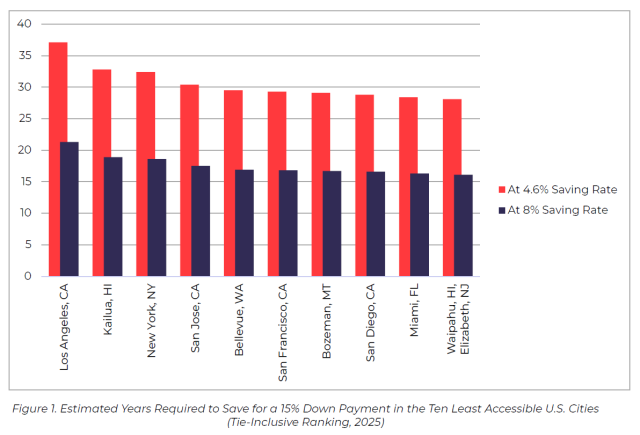
A new analysis by AD Mortgage of housing affordability highlights the growing financial barriers facing prospective homebuyers in several major U.S. cities, areas where high home prices and modest savings rates are significantly extending the time required to accumulate a downpayment.
AD Mortgage’s economists rank the top 10 least affordable cities in 2025 based on typical home values, median household incomes, and the number of years needed to save for a down payment under different savings scenarios.
Leading the pack is Los Angeles, California as the least accessible housing market. With a typical home value of $936,304 and a median household income of $82,263, it would take households more than 37 years to save for a downpayment at a personal savings rate of 4.6%. Even at a more aggressive 8% savings rate, buyers would still need more than 21 years to accumulate sufficient funds. The findings underscore the extreme mismatch between home prices and incomes in the nation’s second-largest metro area.
Several high-cost coastal markets follow closely behind. Kailua, Hawaii, where typical home values approach $1.48 million, and New York City, with average home prices above $800,000, both require more than three decades of saving at lower savings rates and nearly two decades even under moderate savings assumptions.
Technology-driven markets such as San Jose and San Francisco also rank among the least affordable, reflecting the persistence of elevated home values despite higher-than-average household incomes.
The West Coast dominates the list overall, with California cities accounting for four of the top 10 least accessible markets, including Los Angeles, San Jose, San Francisco, and San Diego. Bellevue, Washington, another high-income market, ranks high as well, with typical home values exceeding $1.45 million, and saving timelines approaching 30 years at lower savings rates.
Notably, affordability challenges are not confined to traditional coastal hubs. Bozeman, Montana, appears on the list with a typical home value of $713,133, and a median household income below $80,000, highlighting how rapid price appreciation in smaller markets has outpaced local earning power. Miami, Florida, and Elizabeth, New Jersey, further illustrate how relatively lower incomes can exacerbate affordability pressures even when home prices are comparatively lower than those in California or Hawaii.
Overall, the data underscores the increasing gap between home prices and household incomes across diverse regions. Even under moderate savings assumptions, many households face timelines of 15- to 20-years or more to save for a downpayment.