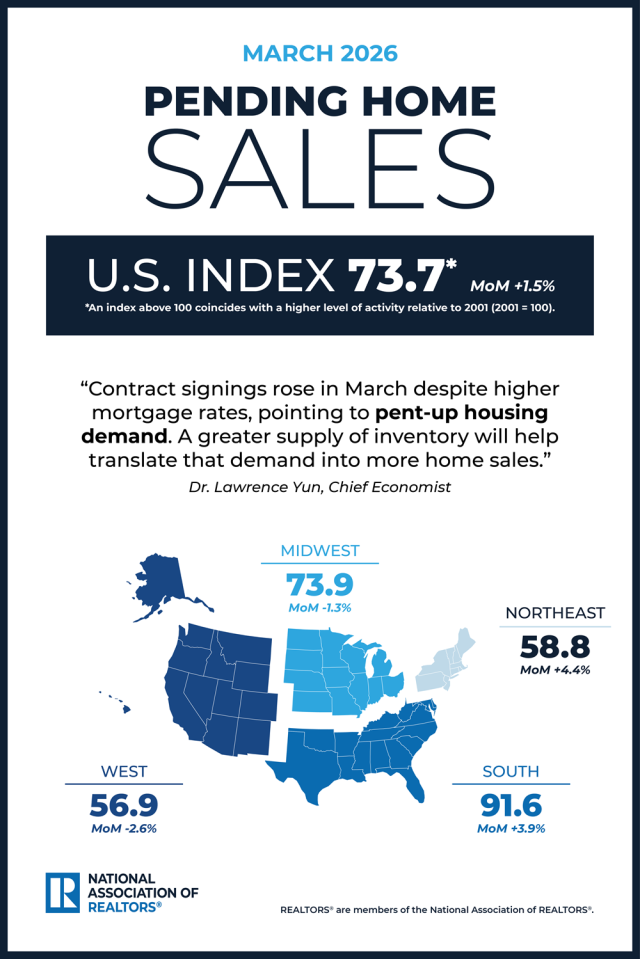
Pending home sales posted a modest gain in March, offering a mixed but slightly improved signal heading into the spring buying season.
The National Association of Realtors (NAR) reported its Pending Home Sales Index rose 1.5% month-over-month in March, while slipping 1.1% year-over-year. The increase came in better than expectations, though contract activity remains constrained compared to last year.
NAR Chief Economist Lawrence Yun pointed to a combination of rising inventory and persistent affordability challenges shaping the current market. While more listings are giving buyers additional options, elevated mortgage rates continue to limit purchasing power.
Regionally, the South led the monthly gains, supported by relatively stronger job markets and more moderate home price trends. That dynamic is also being reinforced by a more favorable stance toward new home construction in parts of the Sun Belt, helping expand supply.
According to Bankrate Principal Analyst Ted Rossman, the March data reflects a market beginning to thaw — but unevenly.
“Pending home sales rose 1.5% month-over-month and declined 1.1% year-over-year in March … These results are a bit better than expected,” Rossman said. “The South fared best, thanks largely to moderating home prices and solid job markets. A friendlier attitude toward home building is also leading to more sales in the Sun Belt.”
Rossman also pointed to shifting conditions in previously overheated markets. Data from Redfin shows that among the 50 largest metro areas, Austin and Dallas have seen some of the steepest year-over-year price declines — a reversal from pandemic-era surges.
That correction is now feeding into transaction activity.
“It’s not surprising … to see both in the NAR’s top 10 for year-over-year pending home sales increases,” Rossman noted. “These markets were red-hot a few years ago, then they came back to Earth a bit, and now we’re seeing some pent-up demand released.”
For mortgage professionals, the implication is clear: pockets of buyer leverage are emerging. Increased inventory and softer pricing in certain metros are shifting negotiating power away from sellers — a dynamic that could help drive purchase volume where affordability improves.
But rates remain the swing factor.
Rossman highlighted that mortgage rates climbed for six consecutive weeks beginning in late February, rising from 6.09% to 6.46% for the average 30-year fixed, before easing slightly in recent weeks. That volatility has weighed particularly heavily on first-time buyers.
“Six percent is an important psychological threshold,” Rossman said, adding that a sustained move back toward or below that level could materially improve affordability — assuming home prices remain stable.
NAR’s data suggests demand hasn’t disappeared — it’s just highly rate-sensitive and increasingly localized. For loan officers, that means opportunity may depend less on broad national trends and more on identifying markets where pricing, inventory, and rate dynamics are finally aligning in the buyer’s favor.