University Financial Associates LLC and University of Michigan
Place-based market risk can produce dramatically different default outcomes among borrowers with nearly identical credit profiles
Disclosure: The author is a principal of University Financial Associates LLC, the firm that developed ForeScore™, the place-based risk measure discussed in this article.
In 1979, my family and I bought our dream home in Vancouver. Over the next eighteen months, local house prices doubled. My one-year mortgage, taken at 12 percent, came up for renewal just as Canadian rates spiked toward 22 percent. Same borrower, same job, same house, same contract — yet the risk to a lender had changed completely.
That's a strange thing for a mortgage to do: hold still on paper while its real risk explodes, without the collateral or the borrower moving an inch. That question drove three decades of my research — and the answer matters for how investors price and manage risk today.
The Blind Spot In Mortgage Valuation
A mortgage rests on two things: a promise and a house. The industry has turned the promise into a science — credit scores, income verification, debt ratios, reserves, all measured and filed before a loan closes, down to the decimal.
Get the NMP Daily
Essential stories, every weekday.
The house gets a single physical exam, then is left alone. An appraiser visits once, a number gets filed, and the collateral often vanishes from the analysis until it resurfaces at refinance or default. But a house is no more a fixed fact than a stock price. Its value keeps moving with local jobs, migration, new construction — the same currents that decide whether a struggling borrower has a way out or a dead end.
Take two borrowers: same credit score, same income, both blindsided by a layoff. One lives where houses move in six weeks — sell, refinance, breathe. The other lives where houses sit for six months — no buyer, no exit, no float. Same shock, same paper, opposite endings. The difference was never the borrower. It was the address.
This isn't rare. It runs through ordinary loans, in ordinary markets, for ordinary borrowers — exactly why it deserves a number of its own, not a footnote.
What The Numbers Show
I sorted more than 12,500 mortgage originations, tracked over seven years, along two axes: traditional credit score, and a composite score for local market strength.
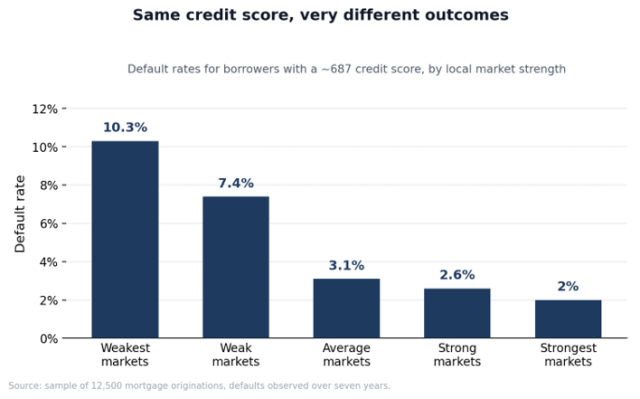
The gap was bigger than I expected. Among borrowers with nearly identical credit scores — in the high 600s, a near-prime band — default rates ran from 2.0 percent in the strongest local markets to 10.3 percent in the weakest. Results are similar in other credit score bands.
Default rates for borrowers with a ~687 credit score, by local market strength
Just over a fivefold gap, among borrowers a credit bureau would call twins — information a credit score cannot see, and most pricing systems are just as blind to it.
Why This Matters For Your Company
None of this argues for going easy on borrowers — income, credit history, and reserves stay the front line. It argues that borrower risk and place risk are separate animals, and most investors track only one.
For leadership, the blind spot shows up in concrete places. Pricing that ignores location isn't neutral — it undervalues the safest borrowers and overvalues the riskiest, market by market. Two portfolios can share an identical average credit score and carry wildly different loss exposure, depending on where the loans sit on a map; a risk committee will never see that in a credit-score average, but they'll see it on a map.
What This Looked Like In The Crisis
The 2008 crisis is the loudest version of this story. Home prices fell nationally, defaults rose, losses spread — but the map was not uniform. Some metro areas cratered for years; others barely flinched. Portfolios built on nearly identical borrower quality produced wildly different losses, and the only variable that explained the gap was where the houses stood. What struck me wasn't the size of the crisis — it was how much of that divergence was visible in advance, once you looked at local fundamentals instead of national averages. The industry had catalogued borrowers down to the decimal and treated the map as an afterthought — exactly what left so many investors blindsided by how unevenly the losses landed.
Getting Started
None of this requires ripping out existing systems. Start by comparing loss rates by local market strength, not just credit-score band — the data already exists; it's just never been asked the question. Then ask your pricing desk what happens today when two loans share a credit score but sit in very different markets. In most shops, the answer is nothing. That silence is the gap.
The Lesson From Credit Scoring
The industry has lived this before. When credit scores went mainstream in the 1980s and '90s, early movers caught mispriced risk competitors missed and priced more accurately doing it. A systematic measure of place could do the same for the half of the risk equation credit scoring was never built to see. The investors who build that discipline in now — instead of waiting for the next downturn to make the gap impossible to ignore — will be the ones still standing when it arrives.
My mortgage in Vancouver didn't change in eighteen months. The place did. Forty-five years later, that's still the risk most of the industry hasn't learned to measure.
University Financial Associates LLC and University of Michigan
Dennis R. Capozza is a mortgage risk researcher with an academic appointment at the University of Michigan and a principal at University Financial Associates LLC, which develops place-based risk metrics for mortgage investors.
Employers added just 29,000 jobs in September, sending Treasury yields lower and offering a potential counterweight to the recent rise in mortgage rates
The September jobs report gave the mortgage market something it hasn't had much of lately: downward pressure on Treasury yields.U.S. employers added just 29,000 jobs in September, while the unemployment rate edged up to 4.2%, according to the Bureau of Labor Statistics. The ...
The wholesale lender is adopting a new identity three years after acquiring Homepoint’s wholesale business and rising to No. 4 in industry rankings
The Loan Store has a new name after a three-year expansion that transformed the once-small wholesale lender into one of the largest players in the broker channel.The Tucson, Arizona-based lender has rebranded as Averra Financial Inc., effective immediately, the company annou...
Employers added just 29,000 jobs in September, sending Treasury yields lower and offering a potential counterweight to the recent rise in mortgage rates
The typical down payment fell 9% from a year ago, while shifting market conditions are giving originators different affordability conversations across the country
New-home sales rose 6.4% in August as builders cut prices, offered incentives, and sold more lower-priced homes. Now mortgage rates are moving against buyers again
ServiceLink finds 45% of surveyed LOs cite borrower reluctance as a barrier, even though most recent buyers say digital options would influence their choice of mortgage provider