Young Americans are buying fewer homes than they were seven years ago, but purchases involving older co-applicants are bucking the trend.
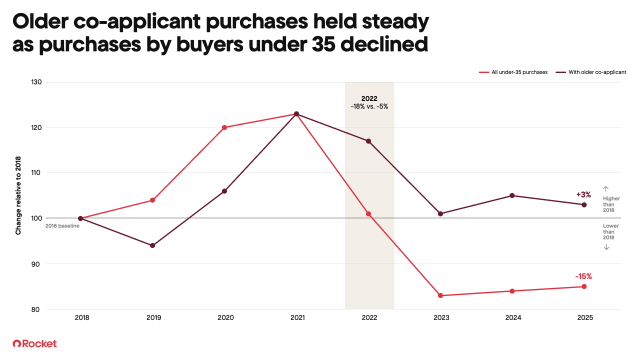
Home purchases by borrowers under 35 have fallen 15% since 2018, while purchases involving a co-applicant age 55 or older have increased roughly 3%, according to a new Rocket Mortgage analysis of Home Mortgage Disclosure Act (HMDA) data released Tuesday.
The share of younger buyers purchasing with an older co-applicant has risen 21% over that period, from approximately one in 36 in 2018 to one in 30 in 2025.
The findings point to a segment of the purchase market that has proved more resilient despite persistent affordability challenges. They also highlight a qualification strategy that can help some buyers get to closing, provided the additional borrower's financial profile strengthens rather than complicates the application.
When Adding A Borrower Helps — And When It Doesn't
Bringing a parent or another older co-borrower onto a mortgage can help a younger buyer qualify by adding income and assets to the application. But the additional borrower also brings debts, credit obligations, and potentially a different credit profile.
The combined financial picture determines whether the arrangement actually improves qualification.
Under Fannie Mae's guidelines, income from a non-occupant borrower can be considered for both Desktop Underwriter (DU) and manually underwritten loans, subject to different requirements.
For manually underwritten loans, the occupying borrower's debt-to-income ratio generally cannot exceed 43% based on their own qualifying income, even when the combined ratio is substantially lower. The maximum loan-to-value ratio is generally 90% when a non-occupant borrower's income is used, compared with 95% for eligible loans evaluated through DU.
DU evaluates the income, assets, liabilities, and credit of all borrowers, regardless of whether they will occupy the property.
Freddie Mac also permits non-occupying borrowers on eligible purchase transactions, with different requirements depending on the underwriting method.
Family-Backed Purchases Prove More Resilient
Rocket's analysis found that purchases by borrowers under 35 dropped 18% in 2022 alone as mortgage rates climbed sharply from pandemic-era lows. By 2025, overall purchases by that age group remained 15% below their 2018 level.
Purchases involving older co-applicants, meanwhile, were approximately 3% higher than in 2018.
“Parents understand the stability a home provides, along with the opportunity to build equity and wealth over time,” said Bill Banfield, chief business officer at Rocket Mortgage. “Many don’t want to see their children delayed or left behind, so they’re willing to join the loan as a co-applicant, adding income to what the family can put behind the purchase.”
The growing role of family assistance in homebuying has surfaced in other research.
An NMP report earlier this year on BMO's findings about Latino homebuyers examined how families are pooling financial resources and turning to multigenerational arrangements to make homeownership possible.
Another NMP report on shared homeownership explored how buyers are joining forces with relatives, friends, and others to overcome affordability barriers.
Rocket's analysis adds a different perspective by examining actual mortgage originations rather than relying solely on surveys of prospective buyers.
The pattern itself isn't entirely new. Freddie Mac previously documented increased use of older co-borrowers among younger first-time buyers, while Redfin reported that 3.3% of homebuyers under 35 had co-borrowers over 55 in 2023.
Rocket's latest figures suggest purchases involving older applicants have remained comparatively resilient even as the broader young-buyer market has contracted.
Where Older Co-Applicants Are Most Common
The trend is particularly pronounced in some of the nation's most expensive housing markets.
In Anaheim, California, approximately one in 13 purchases by buyers under 35 involved a co-applicant age 55 or older in 2025, the highest share among the 50 largest metropolitan areas examined.
Fort Lauderdale, Florida, recorded the fastest growth, with its share rising approximately 68% since 2018.
At the other end of the spectrum, Virginia Beach, Virginia, had the lowest share, at approximately one in 50 purchases. Milwaukee, St. Louis, and Kansas City also ranked near the bottom.
The Obligation Doesn't End At Closing
Helping a buyer qualify with an older co-borrower also means addressing what happens after the mortgage closes.
A non-occupant co-borrower assumes responsibility for repayment even without living in the home. Missed payments can affect both borrowers' credit, and the additional debt may influence the older borrower's ability to obtain financing for another property.
Removing a co-borrower from the obligation later isn't automatic. Depending on the loan and circumstances, it may require refinancing, an eligible assumption, or a lender-approved release of liability.
“When a parent or relative joins a loan as a co-applicant, their full financial picture becomes part of it,” Banfield said. “In the highest cost markets, that combined strength may help put a home within reach. It also means each person is responsible for the full loan amount, so it’s important to have conversations about expectations upfront.”
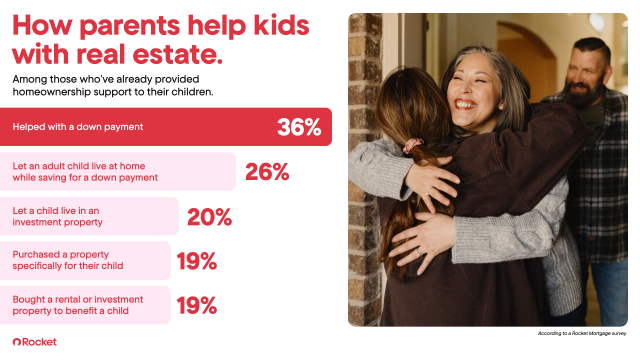
The distinction between an older co-applicant and a parent helping with a down payment is also significant. A financial gift may help cover upfront costs without making the donor responsible for the mortgage. Joining the loan creates a continuing financial obligation.
Rocket's analysis covers HMDA home purchase originations from 2018 through 2025 involving primary applicants under 35 and co-applicants 55 or older. Metro findings cover the 50 largest U.S. metropolitan areas by population.