Slower home price growth and moderate interest rates in the third quarter of 2024 has given California housing affordability a much-needed reprieve on both a quarterly and annual basis, according to the California Association of Realtors (CAR).
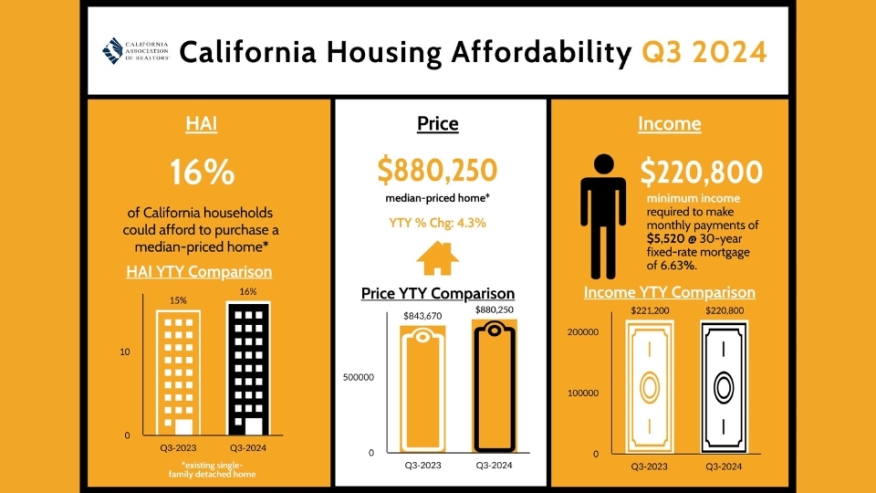
Compared to 14% in the second quarter and 15% last year, 16% of homebuyers could afford to purchase a median-priced single-family home in California in the third quarter, the trade group's Traditional Housing Affordability Index (HAI) revealed, showing affordability easing slightly at the end of 2024.
Yesterday's reading marks a decade since the California affordability index peaked at 56% in the third quarter of 2012. CAR notes that rates bottomed out near 6% in early September, at the start of the third quarter, but steadily returned to 7% through early November.
October's distorted employment data clouded observers end-of-year forecasts for the pace of rate cuts and easing affordability. Nevertheless, the Federal Reserve chose to lower its benchmark rate by 25 basis points at the conclusion of the Federal Open Market Committee's (FOMC) November meeting, Wednesday.
Amidst this volatility, CAR has adjusted expectations of a meaningful decline in interest rates, believing it's a less likely outcome compared to three months ago. Finance heads at mortgage lenders across the country agree, anticipating rate relief as quarters away.
However, home price gains in California have come at a more moderate pace of 4.3% in the third quarter of 2024 – the slowest since the third quarter of 2023. CAR forecasts home prices will soften further as inventory rises and competition cools.
Slower price growth is expected to ease the affordability crunch buyers face, but recent mortgage rate spikes is likely to be a challenge for the remainder of the year.
The minimum annual income of $220,800 is needed to qualify for the purchase of an $880,250 median-priced, existing single-family home in California in the third quarter of 2024, for which a 20% down payment and an effective composite interest rate of 6.63% on a 30-year, fixed-rate loan would produce a monthly mortgage payment of roughly $5,520.
The effective composite interest rate was 7.10% in the second quarter and 7.14% in the third quarter 2023, so monthly principle, interest, taxes, and insurance (PITI) for a typical single-family home fell comparatively.
The median price of existing single-family homes in California declined 2.9% from the previous quarter, due partly to seasonal factors but also a change in the mix of sales. On an annual basis, homes across the state continued to see record price increases for the fifth consecutive quarter.
The share of California households that could afford a typical condo or townhome in the third quarter jumped to 25% from 22% the previous quarter, a rise from 23% in the third quarter of 2023. Annual income of $168,000 was required to make the monthly payment of $4,200 on the $670,000 median-priced condo or townhome in California in the third quarter of 2024.
On the other hand, more than one-third of the nation's households could afford to purchase a $418,700 median-priced home with a required minimum annual income of $105,200 to make monthly payments of $2,630 as nationwide affordability inched up from 34% last year. In the third quarter, the minimum required annual income nationally was less than half of California's for the sixth consecutive quarter.