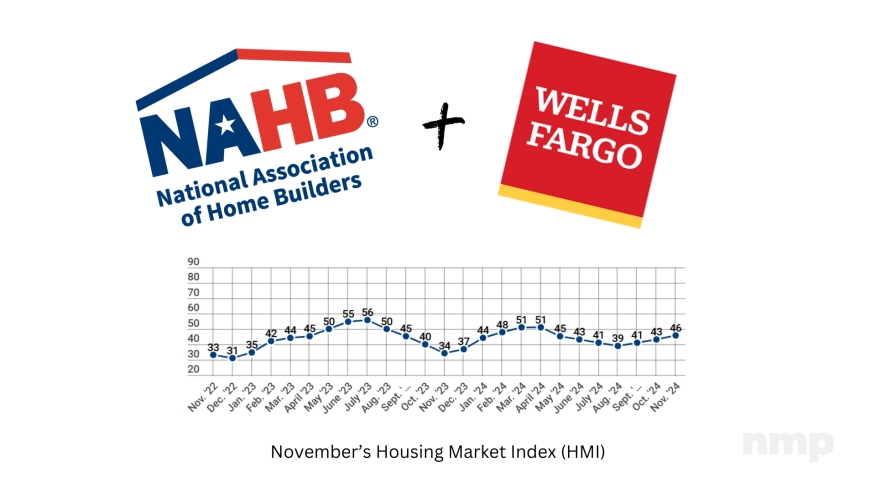
Lifting like a fog, the uncertainty that clouded the minds of many consumers and market participants in the run-up to the U.S. presidential election continues to clear. Reactions to the Republican sweep, and what it means for homebuying, are not restricted to cable network punditry, though.
Optimistic an anti-regulatory majority will grease the gears necessary to encourage residential construction, homebuilders voiced approval of the election outcome in November’s National Association of Home Builders (NAHB)/Wells Fargo Housing Market Index (HMI) with “a huge jump in builder sales expectations over the next six months,” said NAHB Chairman, Carl Harris.
Builder confidence in the market for newly built single-family homes was 46 in November, up three points from October to reach a seven-month high. Sales expectations for the next six months rose to the highest level in nearly two-and-a-half years — an expression of builders’ belief that an administration change “will result in significant regulatory relief for the industry,” Harris added.
All three HMI sub-indices, which includes sales expectations, increased in November, with sentiment about current sales conditions rising two points to 49, sales expectations in the next six months increasing seven points to 64, and the index tracking traffic of prospective buyers posting a three-point gain to 32.
Homebuilders’ acknowledgment of rising traffic among prospective buyers echoes recent findings from Redfin, which saw its Homebuyer Demand Index jump more than 15% between November 7-11 — reaching its highest level in a year-and-a-half — indicating more people were touring homes and researching for-sale listings online post-election.
Meanwhile, mortgage-rate locks for home purchases more than doubled from a month earlier as of November 12, according to Optimal Blue data. The jump in early-stage buying activity reflects pent-up demand being unleashed, helped by a second-consecutive interest-rate cut by the Federal Reserve. But, there’s a catch.
“Buyers were waiting for the election to be over, and for the Fed to cut rates for the second month in a row,” said Chen Zhao, Redfin’s economic research lead. “There’s no question we saw homebuying demand bounce back this past weekend, but it’s bouncing back to the level we would expect with 7% mortgage rates and not much higher.”
With Federal Reserve Chair Jerome Powell voicing uncertainty over an additional rate cut in December, how the market will respond to Republicans’ promises of tariffs, tax cuts, and mass deportations remains highly uncertain. National Association of Realtors (NAR) Chief Economist Lawrence Yun recently forecasted 6-8 interest rate cuts over the span of the next two years.
Headwinds remain, however, for builders, like high prices for building materials and persistent shortages of labor and buildable lots. The first half of 2024 brought average effective rates on loans for land acquisition and speculative single-family construction to their highest since 2018.
“Moreover, while the stock market cheered the election result,” said NAHB Chief Economist Robert Dietz, adding, “the bond market has concerns, as indicated by a rise [in] long-term interest rates. There is also policy uncertainty in front of the business sector and housing market as the executive branch changes hands.”
Persistently high housing costs have eroded new-home affordability for borrowers. The latest HMI survey revealed that 31% of builders cut home prices in November, a share that has remained flat since July, hovering between 31% and 33%. The average price reduction was 5%, slightly below the 6% rate posted in October.
Along regional lines, homebuilders are most optimistic about the Northeast’s market for newly constructed homes, the index for which rose four points to 55 in November. The Midwest rose three points to 44, the South fell forward one point to 42, and the West held steady at 41.