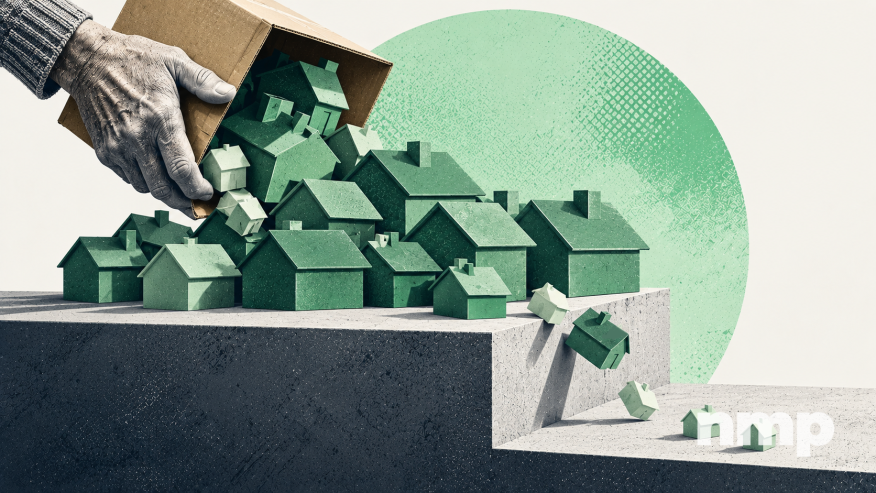
America's aging homeowners are expected to release 13.9 million homes over the next decade, but the coming wave of inventory may do surprisingly little to solve one of the housing market's biggest problems: the shortage of homes for first-time buyers.
Baby Boomers and members of the Silent Generation currently occupy an estimated 36.7 million homes they own, according to new research from Realtor.com. By 2036, that figure is projected to fall to 22.8 million.
That amounts to roughly 1.39 million homes released from older owner-occupancy each year, and 5.9 million more over the decade than older households released during the previous 10 years.
But where those homes sit on the housing ladder matters.
Only about 380,000 of the 13.9 million properties are expected to be starter homes with two bedrooms or fewer.
By comparison, 9.9 million — 71.2% of the total — are expected to be three- or four-bedroom family homes. Another 3.6 million will have five or more bedrooms.
That means the generational handoff may initially create a bigger opening among existing homeowners looking to move up than among renters trying to buy their first home.
More Inventory, But Not Necessarily Starter Inventory
The projected releases are heavily weighted toward larger homes.
About 38,000 starter homes are expected to be released annually, equal to just 3.2% of recent listings in that category. For family homes, nearly 1 million could be released each year, equivalent to 24.7% of recent listings. Large homes could see roughly 360,000 released annually, equal to 67.2% of recent listings.
Those aren't necessarily new listings. Realtor.com defines a "released" home as one vacated by an owner-occupant because of death, a move to institutional care, household consolidation, or a move to a rental.
Even a portion reaching the market could matter. Realtor.com estimates that if half of the family homes released became listings, family-home inventory would increase about 12.3% compared with recent levels.
That could give move-up buyers more choices while potentially putting some of the smaller homes they leave behind back on the market — providing a more indirect inventory benefit for first-time buyers.
The Move-Up Market Could Matter More
Homeowners with mortgages carrying rates well below today's market have been reluctant to give them up, limiting listings, and suppressing the normal chain of transactions in which one household's purchase creates another household's opportunity to buy.
A gradual increase in family-sized inventory doesn't eliminate that rate-lock effect. But more selection — particularly if it brings softer prices or more negotiating room — could give some homeowners another reason to reconsider moving.
Realtor.com's researchers said additional family-home supply could benefit trade-up buyers through greater choice and softer prices, with those purchases potentially freeing smaller properties for other buyers.
That would be welcome in a market where additional inventory has not automatically translated into additional mortgage transactions.
Why Starter Homes Aren't Moving
One reason so few starter homes are expected to turn over may be that their older owners have little financial pressure to sell.
Among starter-home owners ages 70 to 79, 72.8% own their properties free and clear, compared with 65.1% of family-home owners and 58.9% of large-home owners.
That helps explain why the smallest homes have the highest projected retention rate, limiting how much the generational handoff can directly ease entry-level affordability.
A Slow And Uneven Handoff
The transition will also take time. Realtor.com expects annual home releases to rise from about 1.27 million in 2027 to 1.52 million in 2036, with Boomers overtaking the Silent Generation as the largest source around 2029. The peak is likely to come after 2036.
The impact will vary by market, too. Older-owner turnover is expected to be faster in the Rust Belt and Midwest than in expensive coastal markets, with added supply concentrated in family and larger homes and slower-growing markets.
That makes the opportunity more specific than the 13.9 million headline suggests. The near-term opening may be less about a surge of starter homes and more about giving existing homeowners something they've been missing: somewhere to move.