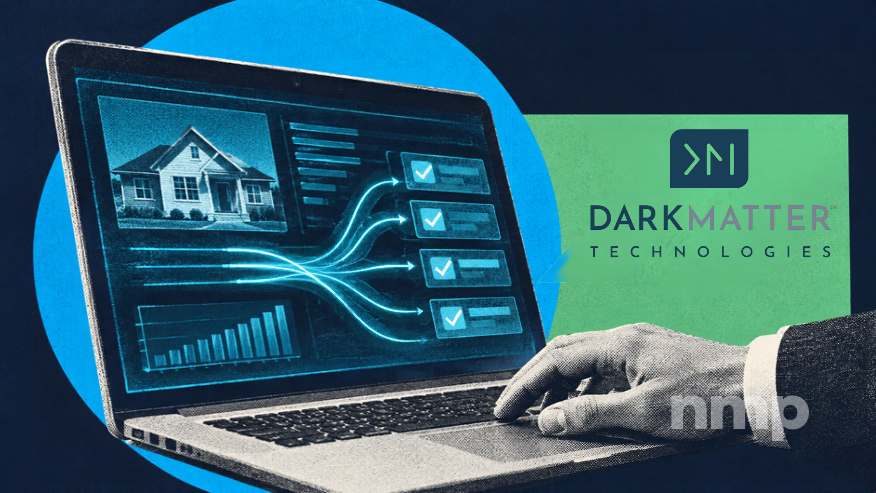
Dark Matter Technologies is taking another step toward automating mortgage production, acquiring an artificial intelligence platform capable of working loan conditions, communicating with borrowers, and performing tasks that have traditionally required loan officers and processors.
The company announced Friday that it acquired the AI agent platform and related intellectual property of House Numbers, a venture-backed technology company whose autonomous agents have been operating on live mortgage files for two years.
The acquisition brings both the technology and its developers into Dark Matter's Empower loan origination ecosystem, accelerating a strategy that has increasingly focused on moving mortgage employees from performing routine tasks to supervising automated workflows.
House Numbers' platform has processed loans for more than 100 lenders, according to Dark Matter. The technology monitors loan files for changes, responds to outstanding conditions, makes recommendations, and communicates with borrowers and lenders through email, text, and voice.
Unlike AI assistants that primarily retrieve information or answer questions, these agents are designed to take action within the loan process, with lender-defined permissions and human oversight.
Automating the work between application and closing could reduce processing touches, shorten turnaround times, and free originators to spend more time generating business.
From Reviewing Documents To Working Loan Files
The acquisition builds on a series of technology initiatives Dark Matter has introduced throughout 2026, each aimed at bringing more automation directly into the loan origination workflow.
In March, the company introduced a managed AI agent framework that allows lenders to deploy agents within Empower using Model Context Protocol, or MCP, with identity controls, data permissions and audit trails.
That framework established how AI agents could securely access loan information and interact with the LOS.
In August, Dark Matter expanded its Aiva Intelligence capabilities, allowing borrowers to receive immediate feedback on uploaded documents. The system can identify whether a document satisfies a loan condition and, depending on lender settings, automatically clear certain conditions or refer them for review.
Then, in October, the company integrated Mezzo's verification orchestration technology, enabling lenders to automatically route verification orders among multiple providers based on cost, coverage, and performance.
The House Numbers acquisition extends that progression beyond document validation and automated routing into more complex loan-processing activities.
Rather than waiting for an employee to identify an outstanding condition, initiate a request, or follow up with a borrower, an AI agent can monitor the file and perform permitted tasks as circumstances change.
The result is a broader effort to make Empower a system that actively moves loans through production, rather than simply serving as the platform where employees manage that work.
The Economics Of Autonomous Origination
Dark Matter CEO Vikas Rao said acquiring House Numbers would accelerate the company's ability to deliver AI capabilities without having to develop the technology internally.
“We’re AI-forward, and we’re disciplined about what we build and what we buy,” Rao said. “House Numbers had already done the incredible work of running AI agents in live production for home lenders.”
The acquisition comes as mortgage technology providers face increasing pressure to demonstrate that AI investments produce measurable operating improvements.
For lenders, the potential savings extend beyond automating individual tasks. Repeated document requests, unresolved conditions, verification delays, and manual handoffs can add time and expense throughout the origination process.
An AI agent that can identify an issue, contact the borrower, and advance the file could eliminate several of those steps.
Keeping Lenders In Control
The expansion of autonomous AI into mortgage production also raises the stakes for compliance, data security, and accountability.
House Numbers developed its platform with controls intended for regulated lending environments, including restrictions on the information each agent can access and the actions it can perform.
The technology uses MCP to connect AI agents with loan files and supporting systems while applying permissions comparable to those governing human users.
A compliance blocklist restricts prohibited actions, confidence-based controls determine when additional review is necessary, and audit trails record activities performed by both employees and AI agents.
Those safeguards become increasingly important as automation moves beyond retrieving information and begins interacting directly with borrowers and making changes within loan workflows.
For lenders, the practical consideration is how much authority to delegate to automated systems while preserving human review of consequential decisions.
House Numbers co-founder and CEO Jeff Levinsohn, who joins Dark Matter as chief AI officer, said the challenge is making AI agents perform consistently within regulated processes.
“The hard part of agentic AI is not getting a model to do a task once,” Levinsohn said. “It is orchestrating complex agentic work safely inside a regulated process and executing valuable tasks consistently at scale, with people in control of the decisions that matter.”
Levinsohn will oversee Dark Matter's AI strategy and development, working with its product and technology teams to integrate the acquired capabilities across Empower, its built-in point-of-sale platform and other products.
House Numbers co-founders Arthur Granado and Benjamin Hoffman are also joining Dark Matter as vice president of engineering and vice president of AI adoption and enablement, respectively.
A Larger Shift In Mortgage Technology
Earlier generations of lending software focused on digitizing applications, connecting data sources and helping employees complete tasks more efficiently. The emerging generation of AI systems is increasingly designed to perform parts of that work independently, escalating exceptions to employees when necessary.
That shift could have implications across retail, wholesale, and correspondent lending operations, particularly for lenders managing large pipelines and seeking to reduce the labor required to move loans from application to funding.
It also places greater importance on how well AI capabilities integrate with existing systems. A tool that automates one task may deliver limited savings if employees still have to transfer information between platforms or manually initiate the next step.
By bringing House Numbers' technology into Empower, Dark Matter is seeking to connect those activities within a broader origination workflow.
The company's growing collection of AI and automation capabilities suggests a strategy centered on reducing the number of manual interventions required to complete a loan.
Terms of the acquisition were not disclosed.