Real estate investors can be some of the most valuable clients an originator will ever work with. They buy repeatedly, refinance properties, build portfolios, and refer other investors. But earning their loyalty requires a different approach from traditional residential lending.
For starters, the lowest rate doesn't necessarily win the deal.
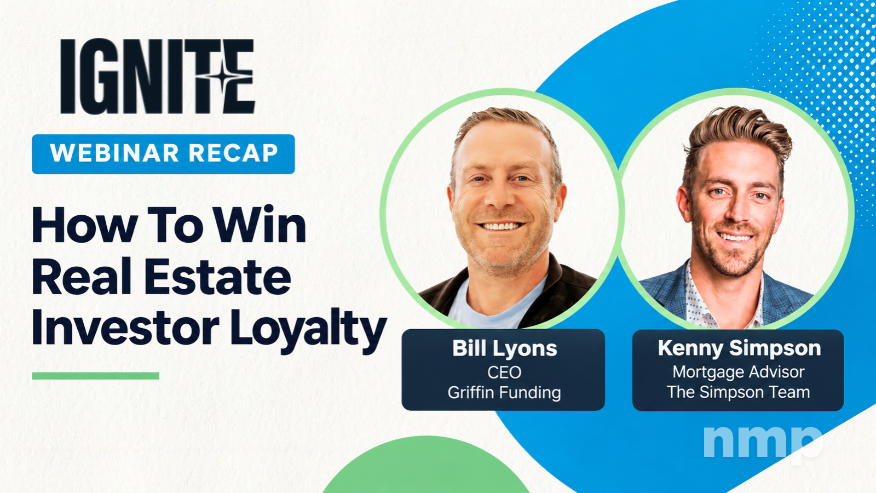
That was a central message from Bill Lyons, founder and CEO of Griffin Funding, and Kenny Simpson, mortgage consultant and founder of The Simpson Team, during NMP's Nov. 3 Ignite webinar, How To Win Real Estate Investor Loyalty.
The two brought different perspectives to the discussion, but agreed that originators who understand investor financing, anticipate problems, and consistently deliver on their promises have an advantage over those competing primarily on price.
It's a substantial part of both businesses. Simpson said real estate investors account for approximately 60% of his production, while Lyons said investor loans represent about 40% of Griffin Funding's volume.
Investors Aren't Shopping Like Traditional Borrowers
Unlike homeowners comparing rates on a conventional refinance, real estate investors tend to evaluate financing as part of a broader business decision.
"They're definitely not as sensitive," Lyons said. "If the numbers make financial sense, economic sense to do the deal, they're going to do the deal. They're not going to worry about an eighth or a quarter."
That doesn't mean lenders can charge whatever they want.
"You still have to be super sharp and very competitive, and in the ballpark, but you absolutely don't have to be the cheapest," Lyons said.
His advice was to prioritize two things: quality and speed.
"I think in non-QM and DSCR, you better be good, and you better be fast," he said. "You know, these people like Kenny was talking about. You know, they don't have time. They want convenience."
Simpson has seen the difference firsthand.
Asked whether he had ever lost an investor loan to a competitor offering a lower rate, he acknowledged that he had, but said the borrower eventually returned.
"I have, but I told them that that lender is probably not going to do the deal, and they were back," Simpson said.
For originators, the distinction matters. A cheaper quote offers little value if the lender cannot approve the property, accommodate an exception, or close within the investor's required timeline.
Stop Quoting Rates and Start Asking Questions
Both speakers argued that originators need to approach investor relationships as advisers rather than order takers.
Simpson said his conversations often begin by learning what the investor is trying to accomplish.
"Are you trying to scale? Are you trying to grow? You know, tell me about yourself. Learn about them. Learn about their business," he said.
That discussion can uncover financing needs the investor may not have considered, including opportunities involving DSCR loans, bank statement programs, or other non-QM products.
Simpson also asks prospective borrowers about their previous experience with non-QM financing and whether competing lenders have explained the terms of their offers.
"Did they explain the prepay? What do you mean a prepay? Is it a five year, three year? These have prepays," he said, describing a typical conversation.
A borrower who receives a quote without understanding the prepayment penalty or other loan conditions may be comparing offers that aren't equivalent.
Lyons similarly encouraged originators to ask better questions and spend more time listening.
"Most of the time, it's just shutting up, two ears, one mouth, listening more than you talk, and having that conversation," he said.
The objective, he explained, is to understand the borrower's motivation and tailor the financing solution accordingly.
"How are we going to handle that if the rent comes in low?" Lyons offered as an example of a question originators should raise before a problem develops.
For investors, that kind of preparation can be worth more than a marginally lower interest rate.
Know Your Guidelines Before You Promise the Deal
Product knowledge emerged as one of the webinar's strongest themes.
"You got to know your guidelines, guys. You got to know your guidelines. You got to be the expert," Lyons said. "You got to print them out and read them old school style with a highlighter and fully understand it."
Simpson warned that originators entering non-QM lending need to understand not only program guidelines but also the lenders behind them.
Some lenders entering the market may advertise attractive rates while having limited flexibility to approve exceptions. Others may have experienced account executives but still require investor approval before committing to unusual scenarios.
The danger comes when a sales representative promises approval without confirming it with underwriting.
"You really need to call your rep and really have that blunt conversation," Simpson said.
He recommended determining whether an exception has been reviewed by an underwriting manager and, when necessary, the investor ultimately purchasing the loan.
"Don't send me back a yes just to get the deal in. It better be a yes, and you did your due diligence," he said.
Lyons agreed that relationships with knowledgeable account executives can be just as important as choosing the lender itself.
"I think it's really about the relationship with the AE more than the lender itself, which is obviously very important too," he said.
The message for brokers was clear: a reliable approval from the right lending partner can be more valuable than an attractive quote that falls apart in underwriting.
Three Problems That Can Kill a DSCR Deal
Lyons identified several operational issues that can derail investor financing, particularly DSCR loans.
Among the most significant are rental-income appraisals that come in below expectations and problems involving limited liability company documentation.
"You got to be prepared for a low appraisal in terms of the 1007 and the rental income," Lyons said.
He recommended having a backup financing option available, including lenders that permit lower DSCR ratios or no-ratio programs, when the property's projected rental income fails to support the original terms.
He also warned that LLC documentation can create unexpected closing problems, particularly when entities are not properly registered or authorized to operate in the state where the property is located.
"Those LLC docs blow up deals all the time," Lyons said.
Simpson emphasized preparing for appraisal problems before they occur.
"For me, appraisals are really, really important because they will break or make a lot of deals," he said.
He recommended researching comparable rents and gathering supporting information early, rather than scrambling to challenge an appraisal after it threatens the transaction.
"Just do the work up front. Tell your client where the rents you're seeing are," Simpson said.
For originators seeking repeat investor business, these details are consequential. A failed closing can cost the borrower an acquisition opportunity and the originator a relationship that might otherwise have produced years of business.
Technology Can Speed Up the Process, but Experience Still Matters
Simpson also described how his team is using artificial intelligence to screen loan scenarios and improve operational efficiency.
His team has loaded lender guidelines into Claude, allowing it to compare prospective transactions against multiple programs and identify potential obstacles.
"We dumped all the guidelines in there, and we can run it against them. We always do double check though, because you never know," he said.
The system can help identify issues involving recently listed properties, accessory dwelling units, or complex LLC ownership structures before the team spends time pursuing an unsuitable lender.
Simpson said his operation also uses CRM workflows, automated borrower communications, and AI-assisted document processing.
But he emphasized that technology does not eliminate the need for verification.
"If you got to get more down the detail, you got to go to them," he said, referring to lenders.
That distinction is particularly important in non-QM lending, where exceptions and investor-specific requirements can determine whether a loan is eligible.
Two Rules for Responsible Investor Lending
Lyons also warned about maintaining underwriting discipline while pursuing growth in non-QM.
"Rules in non-QM: no fraud whatsoever, and no defaults," he said. "Make sure these people are going to repay."
He described evaluating loans through four fundamental underwriting considerations: loan-to-value ratio, income, credit, and assets.
Lyons recounted a bank statement loan that Griffin Funding had to repurchase after multiple weaknesses in the borrower's financial profile combined to create an unacceptable risk.
His broader point was that exceptions should be evaluated in the context of the entire transaction, rather than treated as isolated guideline adjustments.
For originators, that means understanding the borrower's capacity to repay and recognizing when a transaction carries too many overlapping risks.
One Investor Can Open the Door to Many More
Beyond underwriting, both speakers encouraged originators to look more closely at their existing relationships for opportunities to develop investor business.
Simpson said his investor clients frequently become referral sources because other investors want to know which financing professionals are helping them acquire and refinance properties.
"They become a huge referral source for me just because if you take care of them, you do a great job," he said.
Those relationships can also lead to other kinds of mortgage business. Investors with complicated income structures may need bank statement or profit-and-loss-based financing for their primary residences.
Simpson encouraged originators to educate their existing databases about the financing options available to self-employed borrowers and real estate investors.
"Do they know that you do non-QM? Do they even know a non-QM?" he asked.
He recommended consistent educational content through email, video, blogs, and social media, emphasizing clear, borrower-friendly product explanations.
"I just educate people. We all think because we're in this business, everybody knows what everything is. They don't," Simpson said.
Lyons likewise recommended marketing to existing clients and developing specialized digital content aimed at investors.
"Create content around this so you specialize in it, and you're getting in front of people," he said.
For originators accustomed to chasing the next purchase or refinance transaction, investor lending offers a different opportunity: developing relationships with borrowers whose financing needs may continue for years.
But those relationships depend on performance.
As Lyons and Simpson made clear throughout the session, winning an investor's first loan is only the beginning. Understanding the business, knowing the products, and getting the deal closed are what earn the next one.
For more industry insights and practical strategies from mortgage professionals, stay tuned for upcoming NMP Ignite webinars and events. Visit the NMP Events page to explore upcoming sessions and register.