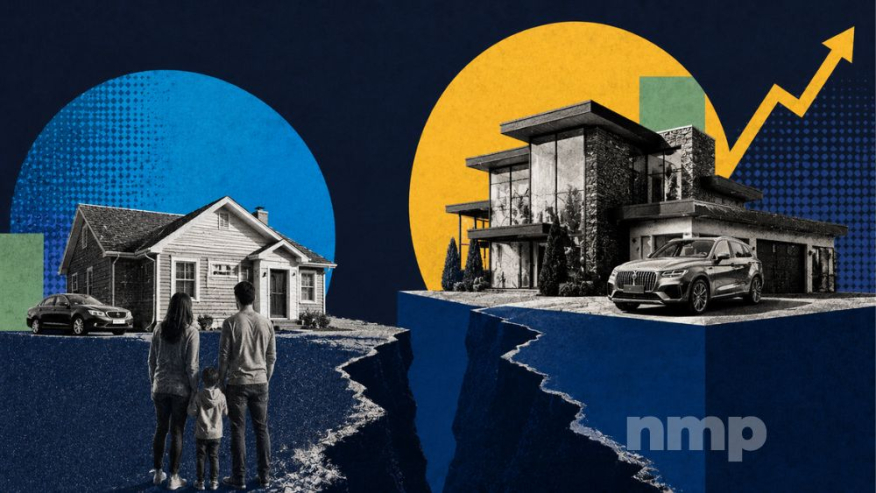
The U.S. housing market isn't moving in one direction anymore.
Instead, it's becoming increasingly divided between markets supported by affluent, equity-rich buyers and those where affordability challenges continue to suppress demand, according to Cotality's latest Home Price Index.
The property data and analytics company reported that U.S. single-family home prices rose 0.8% year over year in May and 0.5% from April, marking a firmer spring than the market experienced a year ago. While appreciation remains modest by historical standards, Cotality said price gains are becoming more geographically widespread even as mortgage rates and housing costs continue to weigh on many prospective buyers.
"The U.S. housing market in mid-2026 remains firmly entrenched in a geographic split, shaped fundamentally by an affordability gap and a wealth gap that continues to divide buyers across the nation," said Dr. Selma Hepp, Cotality's chief economist.
According to Hepp, buyers who have accumulated significant home equity or benefited from recent wealth gains have been less affected by elevated mortgage rates and are helping drive activity in higher-priced markets. Meanwhile, many first-time and move-up buyers continue to face affordability constraints as higher financing costs combine with elevated property taxes, insurance premiums, and other ownership expenses.
AI Wealth, Midwest Affordability Drive Diverging Markets
The strongest appreciation continued to come from two very different parts of the country.
San Francisco posted the highest annual home price increase among the nation's 100 largest metro areas at 8.9%, with Cotality attributing much of the recent acceleration to AI-related investment and wealth creation. According to the report, 7.6 percentage points of that annual gain occurred during the past 90 days.
Meanwhile, more affordable Midwest markets continued to show broad-based strength. Illinois led all states with 5.9% annual appreciation, followed by Maine and Indiana at 5.6%. Lake County, Ind., Milwaukee, and Indianapolis ranked among the fastest-appreciating metro areas during the spring buying season.
Cotality also noted that 38 states reached new home price appreciation highs in May, while 10 states posted negative annual appreciation.
Some Former Boom Markets Stabilizing
Several housing markets that experienced rapid appreciation earlier in the decade continue to cool, although Cotality said some appear to be finding a bottom.
Austin, Texas, recorded a 2.8% annual price decline, while Cape Coral-Fort Myers, Fla., fell 3.3%. However, both markets showed nearly flat price movement over the most recent three months, suggesting values may be stabilizing after significant corrections.
Other previously strong markets have begun to soften as well. Rochester, N.Y., posted the steepest three-month decline among large metros at 1.8%, while New York City and Nassau County, Long Island, also experienced modest price declines during the same period despite remaining positive on an annual basis.
Outlook Calls For Faster Growth
Looking ahead, Cotality forecasts national home prices will increase 4.8% year over year by April 2027, suggesting appreciation could strengthen if market conditions improve.
Still, valuation concerns remain in many parts of the country. According to Cotality's Market Condition Indicators, 72% of the nation's 100 largest metro areas are currently considered overvalued relative to their long-term price trends, while 21% are considered fairly valued and 7% remain undervalued.
The company's Market Risk Indicators identified Greenville-Anderson-Greer, S.C.; Lakeland-Winter Haven, Fla.; Marietta, Ga.; Rochester, N.Y.; and Tampa, Fla., as the markets most at risk for home price declines over the next 12 months.
For mortgage professionals, the report reinforces a trend that has emerged throughout 2026: the national housing market continues to mask sharply different local conditions. While purchase opportunities remain available, success increasingly depends on understanding which markets — and which borrower segments — continue to show resilience despite elevated mortgage rates.