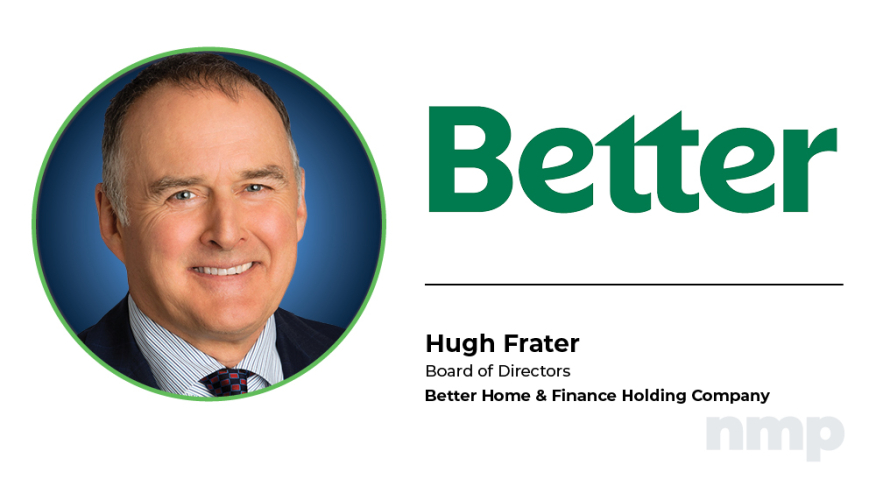
Better Home & Finance Holding Company has appointed former Fannie Mae CEO Hugh Frater to its board of directors, a move the company says will help guide its next phase of AI-driven growth and capital markets expansion.
Frater’s appointment became effective March 23, as Better continues positioning its Tinman AI platform at the center of its lending strategy. His addition brings deep housing finance expertise at a time when nonbank lenders are increasingly turning to automation to streamline origination, underwriting, and secondary market execution.
“Hugh has helped shape the modern housing finance system from the ground up,” said CEO Vishal Garg, citing Frater’s experience across mortgage-backed securities, agency finance, and institutional capital markets.
Deep Capital Markets Experience
Frater is a founding partner of BlackRock, where he helped build its fixed-income and mortgage-backed securities business into what is now the world’s largest asset manager.
He later served as CEO of Fannie Mae from 2018 to 2022, leading the GSE through pandemic-era volatility, including record refinance volumes. Prior to that, he was CEO and chair of Berkadia Commercial Mortgage.
For loan originators, his background signals continued emphasis on secondary market alignment and capital flows as lenders navigate margin pressure and shifting investor demand.
AI Platform At The Center Of Growth
Better said the appointment aligns with its strategy to scale Tinman, which is driving production and partnerships across its platform.
Tinman funded $646 million in Q4 2025 — more than 40% of total volume — while overall funded volume rose 56% year over year, outpacing broader industry growth.
The company has also expanded distribution through partnerships, including a recent integration with Intuit Credit Karma aimed at reaching borrowers through embedded mortgage experiences.
What This Means For LOs
For originators, the move reflects a broader shift: capital markets veterans are increasingly aligning with tech-forward lenders as the industry retools around automation, data, and borrower self-service.
Frater said the industry is “ready for innovation,” emphasizing the need for a more transparent system that connects capital to borrowers efficiently and at lower cost.
That dynamic is already reshaping the LO role, where speed, pricing efficiency, and borrower experience are becoming as critical as traditional sales execution.
Better’s addition of Frater underscores a dual focus on capital markets credibility and AI-driven execution — a combination likely to influence how lenders compete on both pricing and process efficiency in a tighter market.