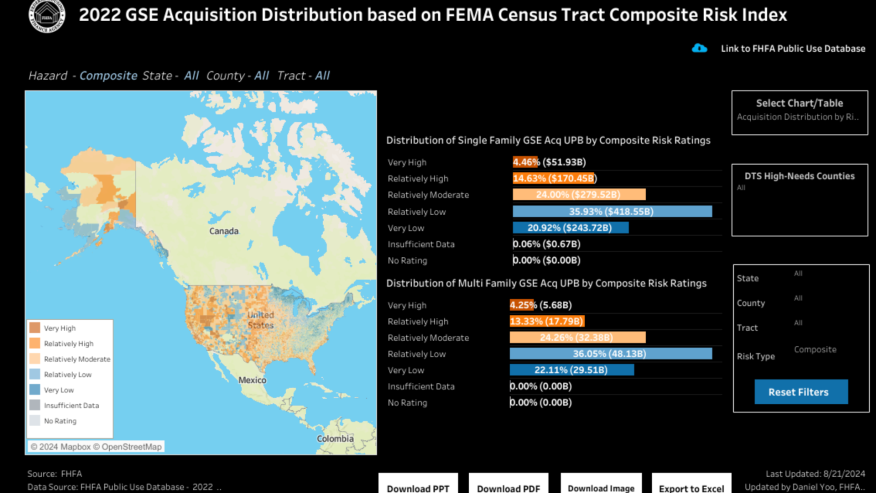
The Federal Housing Finance Agency (FHFA) has released a new tool for homebuyers, real estate agents, loan officers, and industry stakeholders trying to evaluate the myriad risks that climate hazards pose to housing professionals across all regions of the U.S.
The FHFA’s Mortgage Loan and Natural Disaster Dashboard features an interactive, color-coded map that allows users to search census tracts for natural hazards and their anticipated risks to FHFA loans. The tool shows the frequency and financial losses posed by these hazards juxtaposed with loan acquisition counts and total unpaid principal balance (UPB) of loans acquired by the FHFA’s regulated entities within different areas.
The 18 different hazards featured include wildfires, coastal flooding, volcanic activity, heat waves, drought, hurricanes, and tsunamis.
“Climate risks, especially natural disasters, pose a serious threat to housing and other critical infrastructure, particularly in vulnerable communities,” said FHFA Director Sandra L. Thompson. “Providing geographic information on disasters as well as concentrated exposures of loans acquired by our regulated entities can help policymakers and the industry develop solutions to better safeguard those communities from the impact of future catastrophes.”
The FHFA's announcement comes amidst an ongoing homeowners insurance crisis, with policies doubling or even quadrupling in cost over the last few years, particularly in Texas, Florida, and California, where many large insurance carriers have limited their coverage.
Climate disasters are increasing on a yearly basis, straining recovery and rebuilding efforts, especially in economically challenged counties in rural areas. Since 1980 there have been 376 billion-dollar-or-more weather disasters in the U.S., according to the National Oceanic and Atmospheric Administration (NOAA). The cumulative damages of those 376 events exceeds $2.655 trillion.
Property catastrophe rates have increased 50% in 2024 according to Gallagher Re, one of the largest global reinsurance brokers.
Users of the Mortgage Loan and Natural Disaster Dashboard are encouraged to search the FHFA’s Public Use Database (PUDB) for historical data. Combined with current elevated disaster risks, they can identify communities facing economic challenges that are also susceptible to natural disasters.
Along with records from the PUDB, the dashboard utilizes data from FEMA’s National Risk Index, as well as the FHFA’s Duty to Serve High-Needs Rural Areas. Each layer of the application measures an area’s susceptibility to certain disasters using different factors, including social vulnerability and community resilience.
Warnings and high housing costs are often not enough to keep people away from places they want to settle. Recent Redfin data indicated that homebuyers are actually flocking to disaster-prone areas, rather than away from them. In 2023, the nation’s high-flood-risk counties saw 16,144 more people move in than out, while high-fire-risk counties saw 63,365 more people move in than out.
Housing finance and climate experts assembled at AmeriCatalyst's ‘Going To Extremes’ summit this past April, in National Harbor, Md., to discuss the extent of climate change’s unfolding impact and the best available mitigation solutions.